
In this task, n and e are small. I search for “rsa small n and e attack” and find iroot method from gmpy2 module
RSA theory
RSA encryption uses the following parameters:
n- module (product of two large prime numbers p and q)e- public exponent (usually 65537)d- private exponent (secret, required for decryption)m- message (plaintext)c- ciphertext
Encryption: c = m^e mod n
Decryption: m = c^d mod n
iroot
What does iroot do:
iroot(c, e) calculates the integer root of the e-th degree from the number c. Returns a tuple (result, is_accurate).
When working for RSA (Small e Attack):
This method works only when the message m is so small that:
m^e < n
In this case, during encryption, the module does not affect the result, i.e.:
c = m^e mod n = m^e (the modulus is not applied!)
Therefore, you can simply take the root of the e-th degree without knowing d:
m = iroot(c, e)[0] # we get the original messageExample when it works:
# If m = 100, e = 3, n = 100,000
c = 100^3 = 1000000
# But 1,000,000 mod 100,000 = 0 (the modulus is applied here)

# If m = 100, e = 3, n = 10000000 (large n)
c = 100^3 = 1000000
# 1000000 < 10000000, therefore c = 1000000 (no change)
# m = iroot(1000000, 3) = 100 ✓
So, I tried:
from gmpy2 import iroot

c = 8533139361076999596208540806559574687666062896040360148742851107661304651861689
n = 769457290801263793712740792519696786147248001937382943813345728685422050738403253
e = 65537

m = iroot(c, e)
print(m)
And got (mpz(1), False), which means that m^e >= N. So this method does not work.
factordb + python
Let’s try to factor n into prime factors p and q. n is small enough that this won’t take long.
n is small enough that it doesn’t take much time.
I used https://factordb.com:

and write a Python program to find d, calculate c^d mod n (decrypt), and convert the key and bytes:
TIP
This script as well as for other tasks I left here: click
from Crypto.Util.number import inverse, long_to_bytes

c = 8533139361076999596208540806559574687666062896040360148742851107661304651861689
n = 769457290801263793712740792519696786147248001937382943813345728685422050738403253
e = 65537
p = 1617549722683965197900599011412144490161
q = 475693130177488446807040098678772442581573

phi = (p - 1)*(q - 1)

# d = e^(-1) mod phi  | d is within the range from 1 to phi-1
# i.e., the inverse(e, phi) method finds the modular inverse of (e mod phi)
# that is, a number such that (e*d) mod phi == 1
# implements the "Extended Euclidean Algorithm"
d = inverse(e, phi)

m = pow(c,d,n) #c**d mod n

print(long_to_bytes(m))
As indicated in the code above, the inverse method from the Pycryptodome library implements the “Extended Euclidean Algorithm.” That is, it searches for the value d that:
- modular multiplicative inverse of the number
e mod phi - such a number exists ONLY if
GCD(e, phi) == 1 - such a number
d == e^(-1) mod phi(n) - if you multiply
d*eand then applymod phi (d*e mod phi), the remainder MUST be1
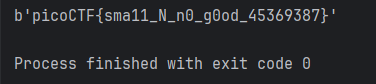
picoCTF{sma11_N_n0_g0od_45369387}